
Trump exempts new nuclear reactors from environmental review
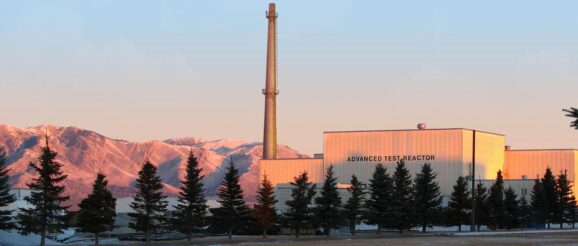
Idaho National Laboratory
The Trump Administration is excluding new experimental reactors being built at sites around the U.S. from a major environmental law that would have required them to disclose how their construction and operation might harm the environment. The law also typically required a written, public assessment of the possible consequences of a nuclear accident.
The Department of Energy announced the change Monday in a notice in the Federal Register. It said the department would begin excluding advanced nuclear reactors from the National Environmental Policy Act. The act requires federal agencies to consider the environment when undertaking new projects and programs.
The law also requires extensive reporting on how proposed programs might impact local ecosystems. That documentation, known as an Environmental Impact Statement, and a second lesser type of analysis, known as an Environmental Assessment, provide an opportunity for the public to review and comment on potential projects in their community.
In its notice, the Energy Department cited the inherent safety of the advanced reactor designs as the reason they should be excluded from environmental reviews. “Advanced reactor projects in this category typically employ inherent safety features and passive safety systems,” it said.
The exemption had been expected, according to Adam Stein, the director of nuclear energy innovation at the Breakthrough Institute, an environmental think tank that studies nuclear power and the tech sector. President Trump explicitly required it in an executive order on nuclear power he signed last May.
Stein says he thinks the exclusion “is appropriate” for some reactors in the program, and notes that previous reactors built by the Energy Department have not been found to have significant environmental impacts.
But critics of the proposed exemption questioned whether the new reactors, whose designs’ differ from earlier ones, really are as safe as claimed.
Until now, the test reactor designs currently under construction have primarily existed on paper, according to Edwin Lyman, director of nuclear power safety at the Union of Concerned Scientists, a non-profit environmental advocacy group. He believes the lack of real world experience with the reactors means that they should be subject to more rigorous safety and environmental reviews before they’re built.
“The fact is that any nuclear reactor, no matter how small, no matter how safe it looks on paper, is potentially subject to severe accidents,” Lyman said.
Seeking Swift Approval
The move to exclude advanced reactors from environmental reviews comes amid a push to build multiple such reactors by the summer.
The Energy Department’s Reactor Pilot Program is seeking to begin operations of at least three advanced test reactors by July 4 of this year. The program was initiated in response to the executive order signed by President Trump, which was designed to help jump start the nuclear industry.
The reactors are being built by around ten nuclear startups, which are being financed with billions in private capital, much of it from Silicon Valley. The goal, supporters say, is to develop new sources of electricity for power-hungry AI data centers.
“DOE follows applicable U.S. EPA requirements in these areas,” it said.
Environmental review not needed
The decision to exclude the reactors from conducting environmental reviews means there will be less of an opportunity for the public to comment. But the environmental review process may not be an appropriate forum for such discussion anyway, Stein noted.
“I think that there’s a need for public participation, particularly for public acceptance,” he said. But he added, “the public just writing comments on an [Environmental Impact Statement] that ultimately would get rejected doesn’t help the public have a voice in any way that would shape any outcome.”
Lyman said that he vehemently disagreed with that assessment.
“I think the DOE’s attempts to cut corners on safety, security and environmental protections are posing a grave risk to public health, safety and our natural environment here in the United States,” he said.